
Step-up SIPs: the ten-minute change that adds 40% to your corpus
Raising your instalment with your salary is the least painful way to invest meaningfully more.
Most people set a SIP once and leave it. Their income doubles over a decade; their instalment does not move. A step-up fixes that automatically.
What a step-up does
You instruct the fund house to raise the instalment by a fixed percentage every year — commonly 10%. A ₹5,000 SIP becomes ₹5,500 in year two, ₹6,050 in year three, and so on. Every increase lands early enough in the horizon to compound.
The size of the difference
A flat ₹5,000 SIP for 15 years at 12% produces roughly ₹25 lakh. The same SIP with a 10% annual step-up produces roughly ₹37 lakh — about 47% more. You never felt any single increase, because each one arrived alongside an increment.
Why it beats simply saving more later
People plan to increase their investing “once things settle down”. Expenses expand to fill income, so the increase rarely happens. Automating it removes the decision, which is the part that fails.
Choosing the percentage
Match it to your realistic annual increment, not your best year. Somewhere between 5% and 10% works for most salaried investors. A step-up you have to cancel in a bad year is worse than a smaller one you never touch.
Where it does not help
If your income is lumpy — freelance, commission-based, business — a fixed annual step-up can hit in a lean month. Consider a smaller base SIP with an annual top-up instead, made when the money is actually there.
Run your own numbers
The step-up SIP calculator on this site shows the stepped-up total next to the flat one, so you can see exactly what a percentage point of step-up is worth over your horizon before committing to it.
Related reading
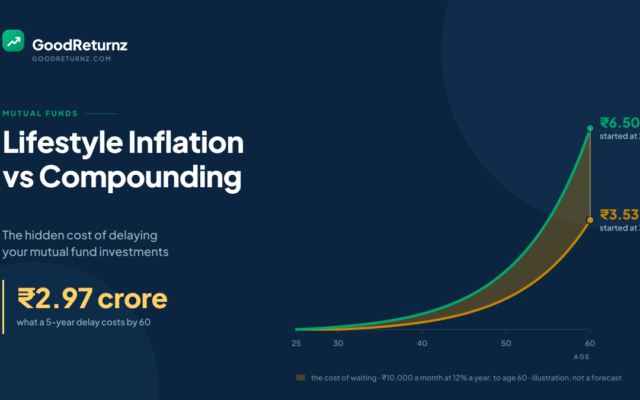
Lifestyle Inflation vs. Compounding: The Hidden Cost of Delaying Mutual Fund Investments
In this articleLifestyle inflation is invisible because it is proportionalWhat a delay actually costsWhy the first years are the expensive…
Why your SIP return is lower than the fund’s published return
The fund says 14%. Your statement says 11%. Both are right — here is the reason.
Step-up SIPs: the ten-minute change that adds 40% to your corpus
Raising your instalment with your salary is the least painful way to invest meaningfully more.