
Why your SIP return is lower than the fund’s published return
The fund says 14%. Your statement says 11%. Both are right — here is the reason.
This is the most common question we get, and the answer is not that the fund is lying. It is that the two numbers measure different things.
Point-to-point versus money-weighted
A fund’s published five-year return is a point-to-point number: what one rupee invested exactly five years ago would be worth today. Your SIP put money in sixty times, on sixty different dates, at sixty different NAVs. The right measure for that is XIRR, which weights each instalment by how long it was actually invested.
Why the gap usually favours the fund
In a rising market, your later instalments — bought at higher prices — have had the least time to compound. Half your money in a five-year SIP has been invested for under two and a half years. The fund’s five-year figure assumes all of it had the full five.
When the gap reverses
In a market that fell and then recovered, a SIP investor often beats the point-to-point number, because the instalments bought during the fall are the ones that had the most room to recover. This is the entire mechanical argument for a SIP, and it is real.
Measuring it yourself
Take your account statement, list every instalment as a negative amount on its date, add today’s value as a positive amount, and run it through an XIRR calculator. That number is your return. It is the only one that reflects your decisions rather than the fund’s calendar.
What to do with the answer
Do not switch funds because your XIRR trails the published return — that gap is arithmetic, not underperformance. Compare your XIRR with the XIRR you would have had in an index fund over exactly the same dates. That is the comparison that means something.
One more thing about costs
If you hold a regular plan rather than a direct plan, roughly one percentage point a year is going to distribution commission. Over twenty years that is not one percent of the corpus — it is closer to eighteen. Check the plan name on your statement.
Related reading
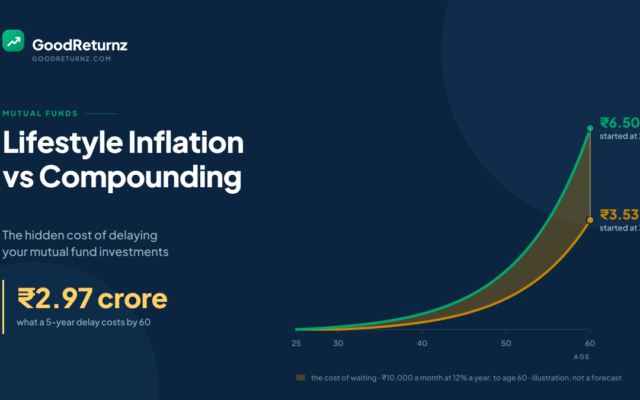
Lifestyle Inflation vs. Compounding: The Hidden Cost of Delaying Mutual Fund Investments
In this articleLifestyle inflation is invisible because it is proportionalWhat a delay actually costsWhy the first years are the expensive…
Why your SIP return is lower than the fund’s published return
The fund says 14%. Your statement says 11%. Both are right — here is the reason.
Step-up SIPs: the ten-minute change that adds 40% to your corpus
Raising your instalment with your salary is the least painful way to invest meaningfully more.