
Lifestyle Inflation vs. Compounding: The Hidden Cost of Delaying Mutual Fund Investments
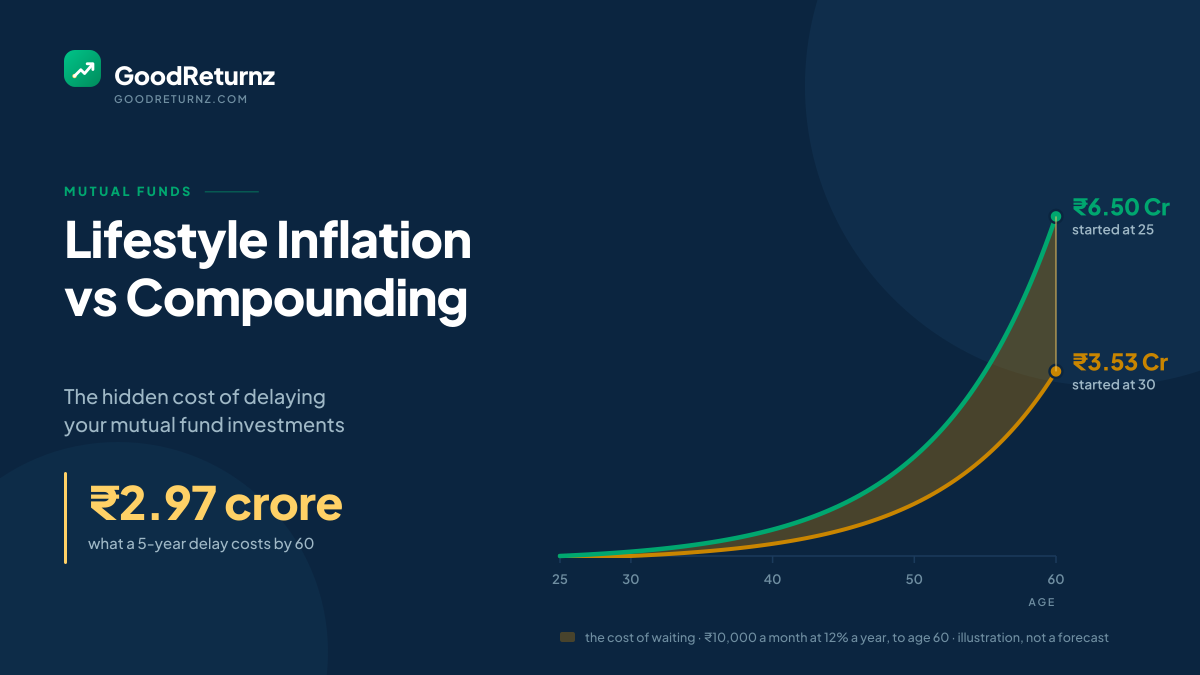
Nobody decides to delay investing. What happens is smaller than that: the appraisal letter arrives, the rent goes up to match the nicer flat, the car gets upgraded, and the SIP you meant to start next quarter stays on the list. Five years later the salary has nearly doubled and the SIP is still the same ₹10,000 — or still nothing at all.
That gap has a price, and it is much larger than the money you didn’t invest. Starting a ₹10,000 monthly SIP at 25 instead of 30 means putting in an extra ₹6 lakh over those five years. At 12% a year to age 60, it leaves you with ₹2.97 crore more. Six lakh of contributions bought three crore of corpus — roughly 49 times what it cost.
This article is about where that multiple comes from, and why lifestyle inflation is the thing that quietly destroys it.
Lifestyle inflation is invisible because it is proportional
Indian companies are budgeting an average salary increase of 9.1% for 2026, slightly above the 9.0% given in 2025. Compounded, that is a serious number: a ₹60,000 monthly salary becomes ₹1.43 lakh in ten years and ₹3.42 lakh in twenty.
Spending almost always rises to meet it. That is not a character flaw — it is what a bigger salary is for. The problem is that the investment usually doesn’t move, and because it doesn’t move, it shrinks as a share of income without anybody noticing:
| Year | Monthly salary at 9.1% a year | A flat ₹10,000 SIP is… |
|---|---|---|
| Today | ₹60,000 | 16.7% of income |
| Year 5 | ₹92,742 | 10.8% |
| Year 10 | ₹1,43,350 | 7.0% |
| Year 15 | ₹2,21,576 | 4.5% |
| Year 20 | ₹3,42,489 | 2.9% |
Nothing was cancelled. No decision was taken. The saving rate simply fell from a healthy 16.7% to a token 2.9%, one increment at a time, while the lifestyle absorbed the difference. This is the mechanism, and it is why “I’ll increase it later” is the single most expensive sentence in personal finance.
What a delay actually costs
Hold everything else constant — ₹10,000 a month, 12% a year, retirement at 60 — and change only the age you begin:
| Start at | Years invested | Total you put in | Corpus at 60 | Cost of waiting |
|---|---|---|---|---|
| 25 | 35 | ₹42,00,000 | ₹6.50 crore | — |
| 30 | 30 | ₹36,00,000 | ₹3.53 crore | ₹2.97 crore |
| 35 | 25 | ₹30,00,000 | ₹1.90 crore | ₹4.60 crore |
| 40 | 20 | ₹24,00,000 | ₹1.00 crore | ₹5.50 crore |
Look at the last two columns together. Between starting at 25 and starting at 40, the contribution falls by ₹18 lakh — but the corpus falls by ₹5.5 crore. The money you didn’t put in explains about 3% of the difference. The other 97% is time.
The same thing, measured one year at a time from age 25:
₹74.2 lakhcost of a one-year delayon ₹1.2 lakh not invested
₹1.99 crorecost of a three-year delayon ₹3.6 lakh not invested
₹2.97 crorecost of a five-year delayon ₹6 lakh not invested
A single year of “I’ll start after the wedding” costs ₹74 lakh at 60. That is not a typo, and it is not a trick of the assumption — halve the return to 6% and the shape of the result is the same, just smaller.
Why the first years are the expensive ones
A SIP instalment is not one investment. It is a separate deposit that compounds for however many months remain until you stop. The instalment you pay at 25 has 420 months to work. The one you pay at 55 has 60.
At 12%, money roughly doubles every six years. The ₹10,000 you invest at 25 gets through nearly six doublings by 60 and turns into about ₹5.28 lakh. The same ₹10,000 invested at 50 manages one and a half doublings and reaches ₹31,058. Identical rupees; wildly different outcomes, decided entirely by when they went in.
This is why a delay cannot be “made up later” on the same terms. The years you skipped were the high-multiple years, and they do not come back. You can only replace them with more money.
What catching up really costs
Suppose you still want the ₹6.50 crore that the 25-year-old reaches on ₹10,000 a month. Starting later, here is the instalment required:
| If you start at | Monthly SIP needed for the same ₹6.50 crore | Multiple |
|---|---|---|
| 25 | ₹10,000 | 1.0× |
| 30 | ₹18,401 | 1.8× |
| 35 | ₹34,228 | 3.4× |
Ten years of delay turns a ₹10,000 commitment into a ₹34,000 one. And here is the cruel part: the person who delayed is usually the person whose lifestyle has already expanded to absorb the extra ₹24,000. The delay makes the fix harder in exactly the same proportion that it makes it necessary.
The fix is not spending less. It is committing the raise before it arrives.
Telling someone to cut their lifestyle rarely works, because it asks them to give up something they already have. Stepping up a SIP works because it asks for a share of money that has not arrived yet, and that nobody has got used to.
The mechanism is simple: instruct your fund house to raise the instalment by a fixed percentage every year. Most call it a “SIP top-up”. You set it once.
Same ₹10,000 start, same 12%, same 30 years — the only change is a 9.1% annual step-up that matches the national average increment:
| Total invested | Corpus at the end | |
|---|---|---|
| Flat ₹10,000 SIP | ₹36 lakh | ₹3.53 crore |
| Stepped up 9.1% a year | ₹1.67 crore | ₹7.98 crore |
That is 126% more corpus. The final year’s instalment is around ₹1.25 lakh a month — which sounds impossible today and will feel ordinary on a salary that has also been rising 9.1% a year for three decades. You never experience the increase as a sacrifice, because it is always carved out of money you have never spent before.
Run it on your own figures — change the step-up percentage and watch what a single point does over a long horizon:
- Invested amount
- Estimated returns
- Invested amount
- —
- Estimated returns
- —
- Total value
- —
- Value without step-up
- —
Figures are estimates for planning only, not investment or tax advice.
If you want to compare a flat SIP against the same amount invested as a lump sum, or check what your existing SIP is actually returning on your dates rather than the fund’s, the SIP calculator and the XIRR calculator do those jobs.
One more thing the corpus number hides
Every figure above is in future rupees, and future rupees buy less. At 6% inflation, ₹1 crore thirty years from now is worth about ₹17.4 lakh in today’s money. Twenty-five years out it is ₹23.3 lakh.
This does not make the exercise pointless — it makes it more urgent, because it means the target is bigger than the round number in your head. A plan built on “₹1 crore should be enough” is usually a plan built on a figure that will buy a fraction of what you imagined. Put your own numbers through the inflation calculator, then work the real target backwards with the retirement calculator.
Three things worth doing this week
- Turn on a step-up on every SIP you hold. Match it to your realistic annual increment — 8% to 10% for most salaried investors. It takes about ten minutes and is the highest-value ten minutes in this article.
- Write down what percentage of your income you invest. Not the rupee figure, the percentage. The rupee figure can stay flat for years and look fine; the percentage tells you the truth.
- Start the SIP you have been postponing at whatever amount is uncomfortable but survivable. ₹2,000 started today beats ₹10,000 started next year — not because ₹2,000 is enough, but because the step-up can raise it and the lost year cannot be bought back.
One caveat on sequencing. None of this comes before an emergency fund and term insurance. A SIP you are forced to redeem in a bad month because the car broke down is worse than no SIP at all — it locks in the loss and breaks the habit. Get the six months of expenses in place first, then make the step-up permanent.
Ten crore SIP accounts in India now contribute ₹32,297 crore a month, and SIP money is 21.4% of the entire mutual fund industry’s assets. The habit is clearly spreading. Whether it compounds into anything depends almost entirely on two numbers: the day you start, and whether the instalment is allowed to grow with you.
Frequently asked questions
I am already 40. Is it too late to start?
No, but the arithmetic changes. At 40 you have 20 years to 60, so the instalment has to do the work that time would have done — which means a larger SIP, a longer working life, or a smaller target. Starting at 40 with a serious step-up is far better than starting at 40 with a flat amount, because the step-up is the only lever still capable of compounding.
Should I increase my SIP or start a new one?
Operationally it makes no difference to the maths. Increasing the existing SIP is simpler to track; a second SIP is useful if you want to add a different fund category. What matters is the total going in each month, not how many instructions it arrives under.
What if I cannot sustain the step-up in a bad year?
Skip it. A step-up you pause for one year still leaves you far ahead of a flat SIP, and most fund houses let you change or cancel the top-up instruction without touching the underlying SIP. The failure mode to avoid is never switching it on at all.
Does a step-up SIP cost anything extra?
No. Fund houses offer the top-up facility free; you pay the same expense ratio on the larger amount. Check that you hold the direct plan rather than the regular one, though — that difference does cost you, and it compounds the same way.
Is lifestyle inflation always bad?
Not at all. The point of earning more is to live better. The problem is only when spending absorbs 100% of every increment, so the investment stays frozen in rupee terms and collapses in percentage terms. Claiming a fixed share of each raise before it reaches your account lets both things rise together.
Figures in this article are calculated with the same formulas as the calculators on this site, and assume instalments at the start of each month. They are illustrations, not forecasts. Mutual fund investments are subject to market risk; past performance does not indicate future results.
Related reading
Why your SIP return is lower than the fund’s published return
The fund says 14%. Your statement says 11%. Both are right — here is the reason.
Step-up SIPs: the ten-minute change that adds 40% to your corpus
Raising your instalment with your salary is the least painful way to invest meaningfully more.
Direct versus regular plans: what one percent actually costs over 20 years
The difference sounds trivial per year. Compounded, it is a fifth of your corpus.